
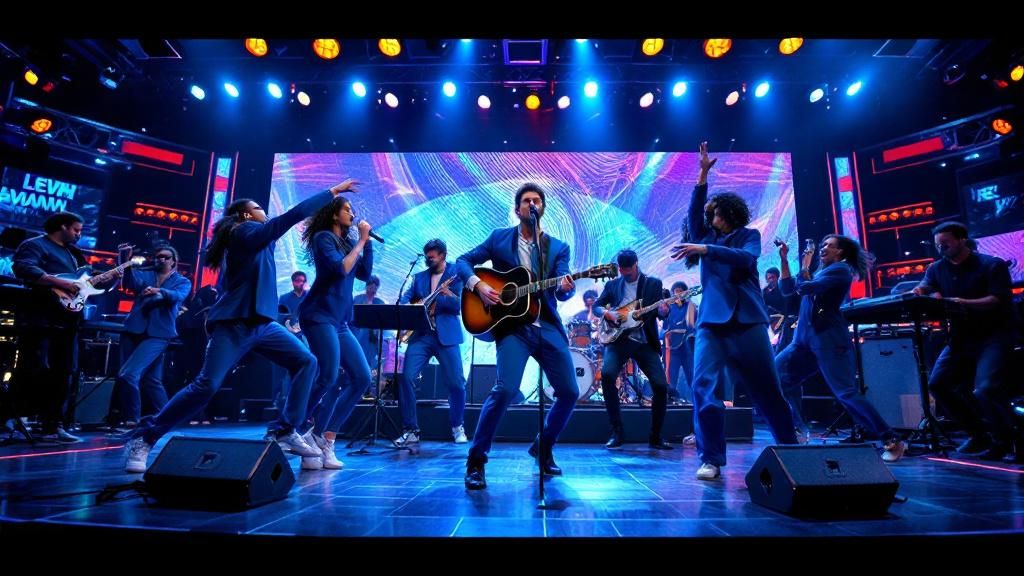
David Byrne contributed dynamic theatrical flair to The Late Show on 31 March, performing a compelling rendition of “When We Are Singing” with Stephen Colbert. The Talking Heads principal artist, joined by a group of blue-clad performers, showcased the full choreographic vision that has become his hallmark. The track hails from his most recent release, Who Is the Sky?, issued in September 2025. During his appearance, Byrne discussed his deliberate shift towards vibrant, visually engaging presentations and described his approach to blending solo material with classic Talking Heads hits on his present tour, including “Psycho Killer” and “Life During Wartime,” whilst upholding artistic integrity.
A Theatrical Come Back to Late-Night TV
Byrne’s performance on The Late Show constituted a triumphant showcase of his developing creative outlook, one that emphasises spectacular visuals and precise choreography. The interpretation of “When We Are Singing” exemplified his willingness to tackle composition with wit and self-awareness, drawing humour from the odd facial contortions singers invariably display during live singing. When exploring his creative decisions with Colbert, Byrne demonstrated an quasi-scholarly interest about the mechanics of singing, pointing out how open mouths of performers produce an unclear look that could suggest either profound pleasure or basic physiological requirement. This cerebral method to live performance distinguishes his work from mainstream pop music.
The aesthetic transformation evident in Byrne’s ongoing tour reflects a deliberate rejection of his former grey staging approach, a conscious choice rooted in current societal requirements. He expressed a distinct philosophy: the times require vibrant visual expression rather than austere minimalism. This shift demonstrates Byrne’s sensitivity to the emotional terrain of his audience and his understanding that visual design conveys significance as compellingly as words or music. By collaborating with his blue-clad ensemble, Byrne has developed a integrated visual aesthetic that supports his musical exploration whilst signalling an hopeful, progressive artistic stance.
- Byrne intentionally chose “When We Are Singing” to highlight absurdity of facial expressions
- Current tour showcases vibrant blue costumes replacing previous grey visual design
- The show includes Talking Heads signature pieces alongside solo material from Who Is the Sky?
- ICE footage woven in strategically at end of “Life During Wartime” for effect
The Creative Vision Behind Who Is the Sky?
David Byrne’s most recent album, Who Is the Sky?, out in September, represents a extension of his enduring investigation into human conduct, perception, and creative expression. The record serves as a artistic fountain for his present touring venture, with “When We Are Singing” exemplifying his ability to draw deep insights from daily instances. Byrne’s method of songwriting remains distinctly intellectual, transforming ordinary observations into compelling musical narratives. The album’s thematic concerns—how we present ourselves, what our expressions reveal or conceal—shape every element of his stage shows, establishing a unified creative vision that goes further than conventional album marketing into something more philosophically ambitious.
The artistic fusion between the fresh compositions and Byrne’s reinvented concert visual approach produces a cohesive experience for viewers. Rather than treating Who Is the Sky? as merely another collection of songs to be performed, Byrne integrates its conceptual framework into the performance and movement dimensions of his shows. This comprehensive strategy demonstrates his decades-long commitment to dissolving boundaries between music, dance, and visual art. By choosing particular pieces like “When We Are Singing” for elaborate theatrical treatment, Byrne demonstrates how modern composition can transcend the studio environment and become fully realised performance art on stage.
Transforming the Concert Atmosphere
Throughout his career, Byrne has continually rejected the idea of static, unchanging concert presentations. His approach stresses constant evolution and responsiveness, treating each series of performances as an occasion to reassess how audiences should engage with music live. The move from muted visual design to bold, vivid visual presentation embodies this investment in artistic evolution. Rather than relying on nostalgia or past achievements, Byrne actively constructs new visual languages that enhance his current artistic preoccupations, ensuring that his performances remain current and deeply affecting rather than merely retrospective.
Byrne’s partnership with his ensemble of blue-clad performers represents a intentional investment in choreographic storytelling. By partnering with trained performers who understand both musical and movement vocabularies, he crafts layered performances where movement, costume, and sound communicate simultaneously. This cross-disciplinary method sets apart his shows from traditional concert formats, positioning them instead as immersive creative experiences. The combination of Talking Heads classics alongside original compositions shows that reimagining doesn’t require discarding one’s history—rather, it involves contextualising past work within new artistic contexts that honour their integrity whilst investigating new possibilities.
Balancing Heritage and Progress
David Byrne’s approach to his catalogue demonstrates a refined comprehension of artistic responsibility. Rather than setting aside his Talking Heads era or being wholly consumed by it, he has developed a framework that permits him to honour the past whilst preserving creative autonomy. This balance necessitates careful curation—selecting which classic tracks deserve to be included in contemporary sets, and how they should be positioned within new artistic frameworks. Byrne’s willingness to perform “Psycho Killer” and “Life During Wartime” alongside solo material exemplifies that legacy need not equate to stagnation or cynical backward-looking sentiment.
The concern Byrne points out—becoming a “legacy act that delivers the old hits”—constitutes a genuine artistic trap that many seasoned artists face. By consciously limiting his dependence on earlier material and continually reinventing sonic landscapes, he maintains creative credibility whilst recognising his past. This method protects both his artistic standards and his fan investment, guaranteeing that concerts function as vital creative expressions rather than nostalgia tours. His resistance to committing to a full Talking Heads reunion further underscores his commitment to artistic evolution over commercial convenience.
Talking Heads Material in Modern Context
When Byrne delivers “Life During Wartime” today, the song holds distinctly contemporary resonance. By securing ICE footage to enhance the track’s close, he converts a 1979 post-punk anthem into a statement about present-day political realities. This curation—showing the imagery only at the song’s end rather than from start to finish—demonstrates sophisticated editorial judgment. The approach recognises the footage’s emotional weight whilst avoiding the performance from turning excessively bleak or preachy, maintaining the song’s creative authenticity whilst deepening its relevance.
This contextual approach transcends mere visual accompaniment. Byrne’s commitment to weaving Talking Heads material into his touring group’s aesthetic framework establishes creative conversation between past and present. The blue-clad dancers and vibrant staging alter the way viewers encounter these familiar songs, removing retrospective preconceptions and insisting upon conscious involvement with their contemporary meanings. Instead of maintaining the songs in amber, this approach permits them to evolve in fresh creative settings.
- Careful inclusion of signature songs forestalls creative repetition and legacy-act status
- Reimagined visual presentation deepens contemporary relevance without undermining artistic authenticity
- Refusing a reunion tour enables Byrne to manage how and when Talking Heads catalogue appears
The Foundations of Achievement
David Byrne’s approach to live performance goes well past simply performing music—it represents a carefully considered creative vision rooted in visual storytelling and spectator psychology. During his appearance on The Late Show, he expressed this viewpoint with typical consideration, describing how ostensibly everyday observations about human conduct inspire his creative choices. His rendition of “When We Are Singing” illustrates this perspective: the song arose from Byrne’s observation that singers’ open mouths during singing generate an unclear expression—one that could imply either profound ecstasy or simple physiological necessity. This wry observation transforms into stage material, showing how Byrne draws from everyday life for artistic substance.
This philosophical framework informs his broader approach to tour production and staging. Rather than approaching concerts as static presentations of pre-recorded work, Byrne views each tour as an opportunity for comprehensive artistic transformation. His determination to introduce the current tour with colour—a calculated contrast to the grey aesthetic of his earlier productions—reflects deeper convictions about the social obligation of art. In his estimation, modern audiences facing uncertain times require visual energy and colour abundance. This isn’t merely a decorative choice; it reflects Byrne’s conviction that performance art bears a duty to elevate and energise, to offer sensory and emotional enrichment beyond the music itself.
The Importance of Colour Today
Byrne’s explicit statement—”the times we live in, we need some color”—reveals how he positions creative choices within wider cultural landscapes. The transition from grey towards vibrant blue-costumed performers and colourful set design reflects his conviction that visual aesthetics hold cultural and emotional significance. This choice acknowledges current concerns and doubts whilst offering an antidote through chromatic abundance. Rather than withdrawing towards austere monochrome, Byrne insists that artistic expression must fundamentally oppose despair through its chromatic vocabulary, converting the performance space into a space of deliberate, necessary colour.
